- Home
- Key Info
- Governing Board
Governing Board
Queens Park Community School Academy Trust (QPCSAT)
All academies are run by trusts. These can be multi academy trusts (MATs) – which run several academies – or single academy trusts (SATs) that run just one. All trusts are charities and so are not run for financial profit.
Queens Park Community School Academy Trust is a Single / Standalone Academy Trust (SAT).
As a standalone academy, our school operates as an independent state-funded school that is self-governing. We have opted out of local authority control and receive our funding directly from the Government. This gives us greater freedom and flexibility over areas such as the curriculum, school hours, staff pay and conditions, and financial decisions.
Contact Details
Chair of Governors: Janet Gordon
Email: governors@qpcs.brent.sch.uk
School Office: Chair of Governors, c/o Queens Park Community School, Aylestone Avenue, London NW6 7BQ
Minutes of meetings are available on request.
Structure
QPCSAT Structure
Our Trust Board of governors (termed Trustees, who are both charity trustees and company directors of the academy trust) oversees the running of the school. It is made up of individuals from different backgrounds such as parents, staff, and representatives from the local community and businesses. The Trust Board provides:
- strategic leadership of the school;
- accountability and assurance;
- and strategic engagement.
To find out more about the role, responsibilities and expectations of a Trust Board, please see the Governance Guide and Academy Trust Handbook.
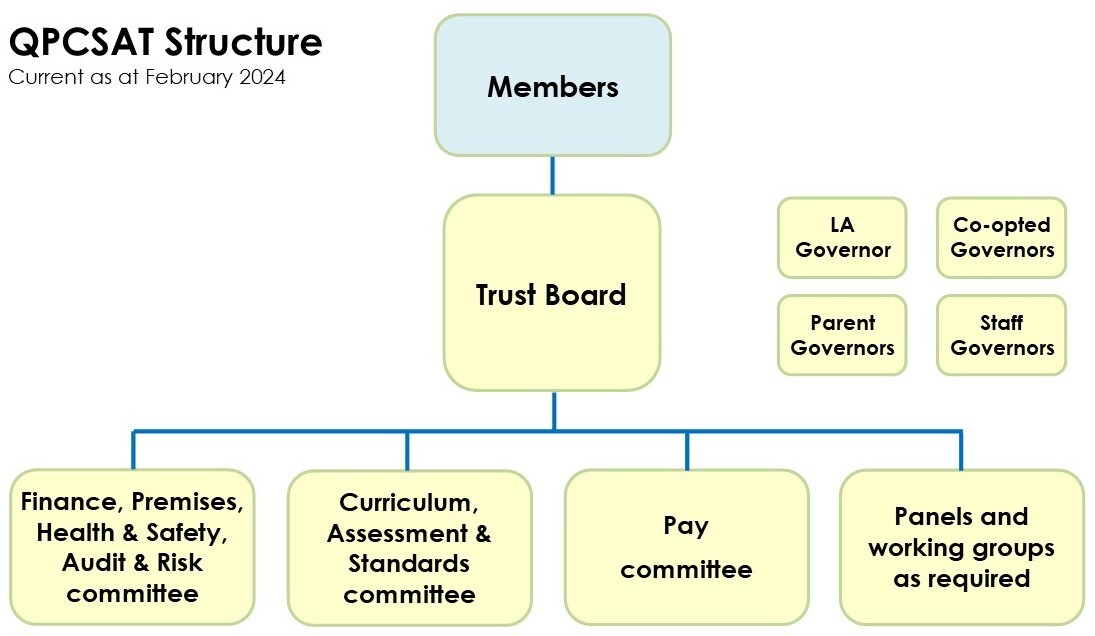
All academy trusts, as charitable companies, have both academy trustees and Members. Our Members oversee the governance structure and long-term vision for the school. The Members appoint the academy's Trustees and ensure the school works towards advancing education for public benefit. The Members work independently from the Board of Trustees and provide objective scrutiny, support and guidance. As guardians of the governance of QPCSAT, the Members review and sign off on any amendments made to the Trust’s Articles of Association which sets out the rules that govern the Trust. They also have the power to appoint and remove Trustees if they fail to fulfil their legal duties properly. Our diverse Members provide expertise in education, business, finance and the local community which aids the trustees in steering the strategic direction of the school. Their insights help maintain high standards in all areas of the standalone academy trust.
Operationally, there is a leadership team consisting of the headteacher, senior leadership team, teachers, and support staff who work together to run the school on a daily basis and deliver high quality education. As an academy trust and public body, we are still subject to Ofsted inspections and national educational policy in areas like assessments, admissions and special educational needs provision. Overall, the standalone structure allows for independent school management while ensuring educational standards are met.
Trustees. Members and Committee Responsibilities
Trustees and Members of QPCSAT
Membership of Committee / Responsibilities
Members of QPCSAT
As charitable companies limited by guarantee every academy trust has Members who have a similar role to the shareholders in a company limited by shares. Members play a limited but crucial role in safeguarding academy trust governance.
The Members of Queens Park Community School Academy Trust are:
Martin Beard
Camilla Child
Marlene Copeland
Janet Gordon
Matt Riddick
Trustees of QPCSAT
The Board meets half termly and meetings are attended by elected and appointed Trustees. Two student representatives, the Deputy Headteacher and other senior leaders attend and speak at governing board meetings but do not vote. The chair of the governing board is Janet Gordon.
Contacting the Board
You can contact the governors by email: governors@qpcs.brent.sch.uk or through the School Office: Chair of Governors, c/o Queens Park Community School, Aylestone Avenue, London NW6 7BQ
Other Statutory Disclosures including Financial Statements etc.
Financial Statements (including annual Governors' Report)
Financial Statements - Year ending 31/8/2025Financial Statements - Year ending 31/8/2024Financial Statements - Year ending 31/8/2023QPCS Governor Attendance 2025-26Register of Business and Personal Interests 2025-26Articles of AssociationFunding AgreementOur Policy on Governors Allowances (Extract from Financial Regulations Manual)
Parent Governor Elections
The Governing Board at this school is made up of appointed and elected Trustees of Queens Park Community School Academy Trust, who are also Directors and are generally referred to as Governors. These volunteers include elected parents and staff, co-opted governors appointed by the Board or the Trust Members and a Local Authority-nominated governor. The term of office of all governors is four years, apart from the Headteacher, who is automatically a governor because of their role.
Who are parent governors?
Parent governors are elected by the parents of registered students at the school and must be a parent or carer of a current student when they are elected. Parent governors may serve out their term of office when their child leaves the school, if they wish.
The term “parent” refers to those adults with parental responsibility known to the school, including foster parents, guardians and carers (with parental responsibility).
Parent governors act in the interests of the school and the children it educates, not as a representative of the parent body. If a parent would like to raise a concern or complaint, they should approach the school, rather than a governor, as governors have a specific role in the complaints procedure.
Governors at QPCS have adopted and are expected to follow the National Governance Association Code of Conduct and the Board’s own additional local Code. Governors declare any actual or potential conflicts of interest and maintain confidentiality, even after leaving office.
Appendix 1 lists the reasons that a person would not be eligible to become a governor.
How are parent governor vacancies advertised?
The Board decides when to advertise vacancies and will make every reasonable effort to inform parents that they are eligible to stand as a candidate and how and when they can vote in a ballot.
How is a candidate nominated?
Parents will be advised that there is a parent governor vacancy or vacancies and will be invited to nominate themselves and provide a brief statement about why they would like to be a governor and what they think they could contribute to the Board, to be shared with parents in the event of an election.
If the number of nominations match the number of vacancies, the parent governor(s) will be “elected unopposed” on the nomination deadline and no election is needed.
If the number of parent governors on the Board is less than two and no parents stand when a vacancy is advertised, the Board can appoint a parent of a registered student or if this is not reasonably practical, a person who is the parent of a school-aged child.
If there are more nominations than vacancies, there will be an election.
How does the election process work?
Who can vote in an election?
Each parent of a registered student has one vote per vacancy, irrespective of how many children they have in the school. A parent cannot vote more than once for any one candidate.
How do parents vote?
Details of the election will be shared with parents, including the names and statements of the candidates, information about how to vote and the deadline. The preferred method of voting will be electronic.
Online voting
The aim of using online voting is to make the process as accessible as possible to parents.
Parents will be asked to provide their names and a contact email as a means of verifying their eligibility to vote. These details will only be accessible to a trusted administrator and the Returning Officer, who will treat the information in absolute confidence.
In the unlikely event of duplicate voting, only the latest submission from a parent will count.
Paper voting
Where the school does not hold an email address for a parent or a parent is unable to vote online, reasonable efforts will be made to provide a paper ballot form.
The completed form should be returned to a box in Reception using double envelopes: the voting slip will be placed in a sealed, unmarked envelope, then placed in a second, outer envelope with the parent’s name and their eldest child’s name and form on the front. This means that the school can check eligibility to vote, but the ballot paper remains anonymous.
What happens when voting closes?
The Returning Officer will conduct the count in the presence of an independent witness, who may be the administrator, as mentioned above, or another independent witness, to verify the process. All candidates will be invited to view the count data on the closing day of voting. This will be anonymised data that indicates the number of votes received by each candidate only and not the identity voters to protect the integrity of the secret ballot.
All persons concerned in the administration of the ballot will maintain the secrecy of the ballot and will not disclose details of how individual parents have voted.
Any election data will be kept secure and then destroyed in line with the school’s Data Protection policy.
What if there is a tie?
First, the votes will be recounted to check the result. If there is definitely a tie, a second election will be run between the tied candidates only, using the same personal statements.
How will the election results be shared?
The candidates will be informed first, then the results will be shared with parents. The new parent governor(s) will be invited to complete a Disclosure and Barring Service (DBS) and Section 128 check, as required in the statutory guidance Keeping Children Safe in Education as soon as possible after the election.
Where can I find out more information about becoming a governor?
If you would like to know more about the role of governors and about becoming a governor at QPCS or another school, please contact governors@qpcs.brent.sch.uk or visit the Governors for Schools website.
The Board will keep the election procedure under review to ensure it remains up-to-date and fit for purpose.
Appendix 1: Reasons for disqualification
According to the Board’s Articles of Association and relevant guidance, a person is disqualified from being a trustee if they:
- Are aged under 18 at the date of their election or appointment
- Are a current pupil at an academy in the trust
- Have been declared bankrupt or, are the subject of a bankruptcy restrictions order or an interim order
- Have had their estate seized for the benefit of creditors and the declaration of seizure hasn’t been discharged, annulled or reduced
- Are disqualified under the Company Directors Disqualification Act 1986
- Are subject to an order made under section 429 (2) (b) of the Insolvency Act 1986, which is failure to pay under county court administration order
- Are disqualified from being a trustee due to any provision in the Companies Act 2006
- Are disqualified from acting as a trustee due to section 178 of the Charities Act 2011
- Have been removed as a trustee for a charity by an order made by the Charity Commission or the High Court on the grounds of misconduct or mismanagement in administration of the charity
- Have been convicted of a serious criminal offence
They can also become disqualified from continuing as a trustee if they:
- Are incapable by reason of illness or injury of managing or administering their own affairs
- Are absent, without the permission of the trustees, from all full Board meetings held within a period of 6 months from the first meeting that the person misses and the trustees resolve that their office be vacated